Showing posts with label Buddhism. Show all posts

Angulimala II

Angulimala II

For years Angulimala terrorized the countryside and townships. Because of his intelligence and daring expertise, he was never caught. Villages were deserted and the jungle tracks fell into disuse for fear of him. King Pasenadi finally ordered a detachment of soldiers to capture him. Dead or alive, Angulimala had to be caught at all costs.
However, Angulimal’s mother came to know just in time what was going to happen to her son. Determined to save her only son, whom she loved so dearly, she hastily made for the jungle where she knew he was hiding in order to warn him. Angulimala saw his mother coming and, gladdened that the last finger he required would soon be his, rushed forward with a raised sword to strike the poor lady who had given him birth and who had raised him up with great love and care.
Before the act of ultimate crime was committed, however, the Compassionate Buddha, who also had come to know what was going on, appeared before Angulimala and intercepted him just in the last moment.
Like a mad elephant, the bandit turned toward the Buddha, who was then walking away in the other direction. He ran after him, determined to finish his task. But however hard he tried, he could not come close enough to strike the Buddha with his sword that had drunk the blood of so many human lives.
This was a miracle. Angulimala only exhausted himself while the Buddha was walking at a leisurely pace.
At last Angulimala stopped. It was the first time he ever had to admit defeat. Still trying to catch his breath, the stone-hearted bandit cried out, “Stop! You there, hold it!”.
“I have stopped.” Said the Buddha still walking, “but you have not.”
Angulimala was puzzled.
“You’re lying!” he shouted even louder. “You’re walking, but you said you had stopped. I have stopped but you said I had not.”
Come the Buddha’s reply: “Angulimala, I have stopped doing evil. I have also given up running after pleasure. I have stopped from doing bad deeds, from speaking evil speech, and from thinking unwholesome thoughts! Come, Angulimala! Listen to the noble doctrine!”
The Buddha then proceeded to deliver a sermon to Angulimala. hiswords so completely changed Angulimala that the latter decided then and there to seek permission to enter the holy Order. he was later ordained by the Buddha at jeta Grove, while the angry populace were yelling at the king's palace for his blood. Little did they know of what was going on at the monastery.
Angulimala's holy life was by no means an easy one. Although he was pardoned by King Pasenadi, who was himself a staunch supporter of the Buddha, the people did not forget his past misdeeds. When he went outside the monastery, they fell on him with a vengeance, but on the advice of the Buddha he silently endured their wrath and radiated the thought of love and kindness to them. Gradually, he was able to win their love and respect and, eventually, became one of their most trusted spiritual preceptors.
Angulimala trained himself with great diligence and patience and finally attained Arahantship. His life demonstrtes that it is never too late to change yourself for the better.
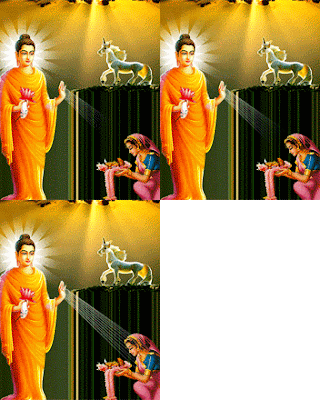
Buddhism and women


In ancient India the position of women dose not appear to have been a very happy one. Generally women seem to have been looked upon as being inferior to men. And, at times they were considered as being on the same level as the Sudras, wiew appears to be that they had to be under the care of parents in their childhood, under the protection of husbands in their youth; and in their old age they had to be under the control of their sons. Therefore, it was thought that they fo not deserve any freedom. Their main role was considered to be that of housewives, managing the affairs in the house according to the wishes of their husbands.
Even as a wife the life of a woman was often miserable. This was specially so when she had the misfortune of being a co-wife. Jealousies and conflicts between co-wives were a common feature in ancient Indian society. The widw’s plight was still worse. Normally, a window was noit allowed to remarry. It is said that a widow had to kill herself by jumping into the funeral pyre of her husband.

Women did not have educational freedom. Education was not considered as being of any importance to women. Their religious freedom, too, was restricted. As they had only little freedom, their chances of performing meritorious religious rites, too, were very limited.

Generally a woman was considered a burden on the family because the males had to bear the responsibility of looking after her. Besides, she was incapable of performing religious rites for the well -being of the departed parents, and therefore, she was considered as being of little use. This is why the birth of a female child was considered as a sign of misfortune in a family. Parents prayed for the birth of sons, both to carry on the family name and traditions and also to perform the necessary religious rites for their benefit when they are dead and gone. How miserable the father felt at the birth of a daughter is seen from the event connected with King Pasenadi Kosala. When this King was informed that his queen gave birth to a daughter he come to the Buddha and lamented. The Buddha had to pacify him saying that good daughters are as good as good sons.

Buddhism dose not consider women as being inferior to men. Buddhism, while accepting the biological and physical differences between the two sexes, dose consider men and women to be equally useful to the society. The Buddha emphasises the fruitful role the women can play and should play as a wife, a good mother in making the family life a success. In the family both husbands and wives are expected to share equal responsibility and discharge their duties with equal dedication. The husband is admonished to cansider the wife a friend, a companion, a partner. In family affairs the wife was expected to be a substitute for the husband when the husband happened to be indisposed. In fact, a wife was expected even to acquaint herself with the trade, business or industries in which the husband engaged, so that she would be in a position to manage his affairs in his absence. This shows that in the Buddhist society the wife occupied an equal position whit the husband.

The Buddha’s advice to the King Pasenadi Kosala, who was a close devotee of his, clearly shows that Buddhism dose not consider the birth of a daughter as a cause for worry and despair.

Buddhism does restrict neither the educational opportunities of women nor the religious freedom. The Buddha unhesitatingly accepted that women are capable of realizing the Truth, just as men are. This is why he permitted the admission of women into the Order, though he was not in favour of it at the beginning because he thought their admission would create problems in the Sasana. Once women proved their capability of managing their affairs in the Order , the Buddha recognize their abilities and talents, and gave them responsible positions in the Bhikkhuni Sangha. The Buddhist texts record of eminent saintly Bhikkhunis, who were very learned and who were experts in preaching the Dhamma. Dhammadinna was one such bhikkhuni,n Khema nad uppalavanna are two others.

The theri-gatha contains numerous stanzas that clearly express the feelings of joy experienced by saintly bhikkhunis at their ability to enter the Order and realize the Truth.

BUDDHISM AND WORLD PEACE

Now a days we talk much about world peace and fundamental rights of the people. The entire world is vocal to guard the human rights and fundamental rights. For this purpose, united nations organisation was set up. It is seen that human right affair's organisations have been established in almost all the counties of the world. Many such establishments have also been created in our country.


To be continue.........

Buddhism

Writer : Mashrura Marzan (Mashrura Marzan she is student of Independent University, Chittagong Campus)

Buddhism is one of the world's oldest religions. Buddhism is a family of beliefs and practices considered by most to be a religion and is based on the teachings attributed to Siddhartha Gautama, Commonly known as ''The Buddha'' (the Awakened One), who lived in the northeastern region of the Indian subcontinent. He likely died around 400BCE.


Life of Buddha :

The name of the founder of Buddhism was Sidhartha Gautama, with Buddha being am honorific title given to him after he attained Samma-Sambodhi (perfect enlightenment) Born about 563BC, the son of King Suddhodana, ruler of Kapilavastu, a principality on

the border of modern Nepal. Siddhartha renounced the splendour and comfort of princely life in his 29th year in order to discover the origin of suffering and the means of extirpating it. At the age of 35 , under the bodhi tree on the banks of the Niranjana at Gaya, he seemed to have succeeded in his quest for perfect wisdom and deliverance and henceforth was called the Buddha, the "Awakened" or "Enlightened" one.

Buddhist concept:

The Buddha was neither a god nor a prophet. While he was a prince, he was still an ordinary man, awakened to the highest truth by his own efforts. He did not claim to be a savior. Instead, he exhorted his follower of depend upon themselves and work out their own salvation. According to him, 'You yourself must make the effort; Buddha's only point the way.

Buddha taught revolves around the problem of suffering. The truths the discovered and propound concerning this most practical and vital question of life are traditionally known as the Four Noble Truths:

1) Suffering  (Dukkha)
2) The Arising of Suffering (Dukkha-Samudaya);
3) The Extinction of Suffering (Duddha-Nirodha) and
4) The Way to the Extinction of Suffering ( Duddha-nirodha-Gamani-Patipada).

Buddhism , however, does not advocate an attitude of hopelessness toward life and should not to be labelled pessimistic. The Buddha perceived the universality of sorrow realistically and suggested that the way to end this universal sickness of human life was by attaining Nirvana, the extinction of craving that causes suffering. This state is to be realzed by developing the Fourth Noble Truth known as the Eight-fold Path (Astangika-Marga) which consists of

Right Understanding (Sammaditthi);
Right Resolve (Samma Sangkppa);
Right Speech (Samma Vacha);
Right Action (Samma Kammanta);
Right Livelihood (Samma Ajiva);
Right Effort (Samma Vayama);
Right Mandfulness (Samma Sati; and
Right Concentration (Aamma Samdhi).

The eight steps are grouped under three headings ; the first two are caller wisdom (Prajna)' the next three morality (shida) and the last htree are known as meditation (samadhi) which must be harmoniously cultivated in order to attain Nrvana. The buddha was concerned with the familiar and everyday world, not an after-life. Nirvana is to be realized in this world and not in some transcendental realm.

Furthermore, the Buddha explained the cause and origin of suffering not bt positting a creator or first cause. But by his Doctrine of Dependent Origination (patichchasamutpada), according to which, everything in the world is related to, contingent upon and conditioned by something else'.

On this doctrine are based the three other theories taught by the Buddha: namely, the theory of impermanence (anitta), the theory of no soul (anitta) and the theory of karma. Buddhaism teaches that all things flow ceaselessly, everything is subject to change and decay and so there is no abiding substance called the soul. The theory of karma is a principle of universal causality, stating that one has to reap the consequences  of one's actions, so that the suffering of human beings is of their own making and it is only they who can eradicate it, if they choose, by their own efforts and actions.

The teachings of the Buddha have been handed down in Pali and have been preserved in three voluminous collections of books known as the "Tripitaka". The word "Tripitaka" means Triple Baskets or three parts. These are:

*) The Basket of Discipline (Vinayapitaka) dealing with the rules of the monastic order;
*) The Basket of Discourses (Suttapitaka) containing the Buddha"s numerous discourses, dialogues, sermons, verses etc.; including his doctrine as summarized in the Four Noble Truths;

*) The Basket of Ultimate Doctrine ( Abhidhammapitaka) comtaining texts that enumerate and explain the teachings of the Suttapitaka in systematic and philosophical form.

The Tripitaka is the sacred literature of the Theravada od Hinayana sect. Mhayana literatur includes the Mahayana Sutras, also caller Vaipulya Sutras, which are traditionally believed to have been proclaimed by the Buddha. Perhaps the most famous and the most representative as well as the most ancient Mahayana literature is constituted by Prajnaparamita Sutras, containing the Buddha's discourses on the perfection of wisdom (Prajna).

Preaching of Buddhism:
After the Buddha passed away (parinirvana), controversies arose amongst his followers with regard to the exact interpretation of his teachings. Although such disputes were resolved in the firs Council of about five hundred leading monks held at Rajagriha, renewd controversy about a century after he Buddha's death, resulted in a schism within the Sangha in the second Council held Vaishali. The elder members of the Sangha, who preserved and upheld the orthodox and ancient doctrines of their teacher, were called Theravadins, and the dissenters, who held separate and unorthodox vies, came to be known as Mahasanghikas. This division of the Buddhist Sangha into two factions is said to have eventually given rise to as many as eighteen buddhist sects.

Historically, however, the most important divisions  of Buddhism are Hinayana and Mahayana. The followers of Mahayana, literally, 'treat vehicle', claim that their religion as taught by the. . . . .


TO BE CONTINIUE. . . . . .
 

This site is very

Image

Image